In the highly competitive health insurance industry, where trust, speed, and personalization are critical, implementing a Customer Relationship Management (CRM) system is no longer optional—it is a strategic necessity.
Modern insurance providers do more than just sell policies. They must manage long-term relationships, deliver continuous support, and comply with strict regulations. In this environment, a CRM helps centralize information, automate processes, and enhance the overall customer experience.
In this article, we explore the leading CRM systems available for health insurance companies and how to implement them effectively.
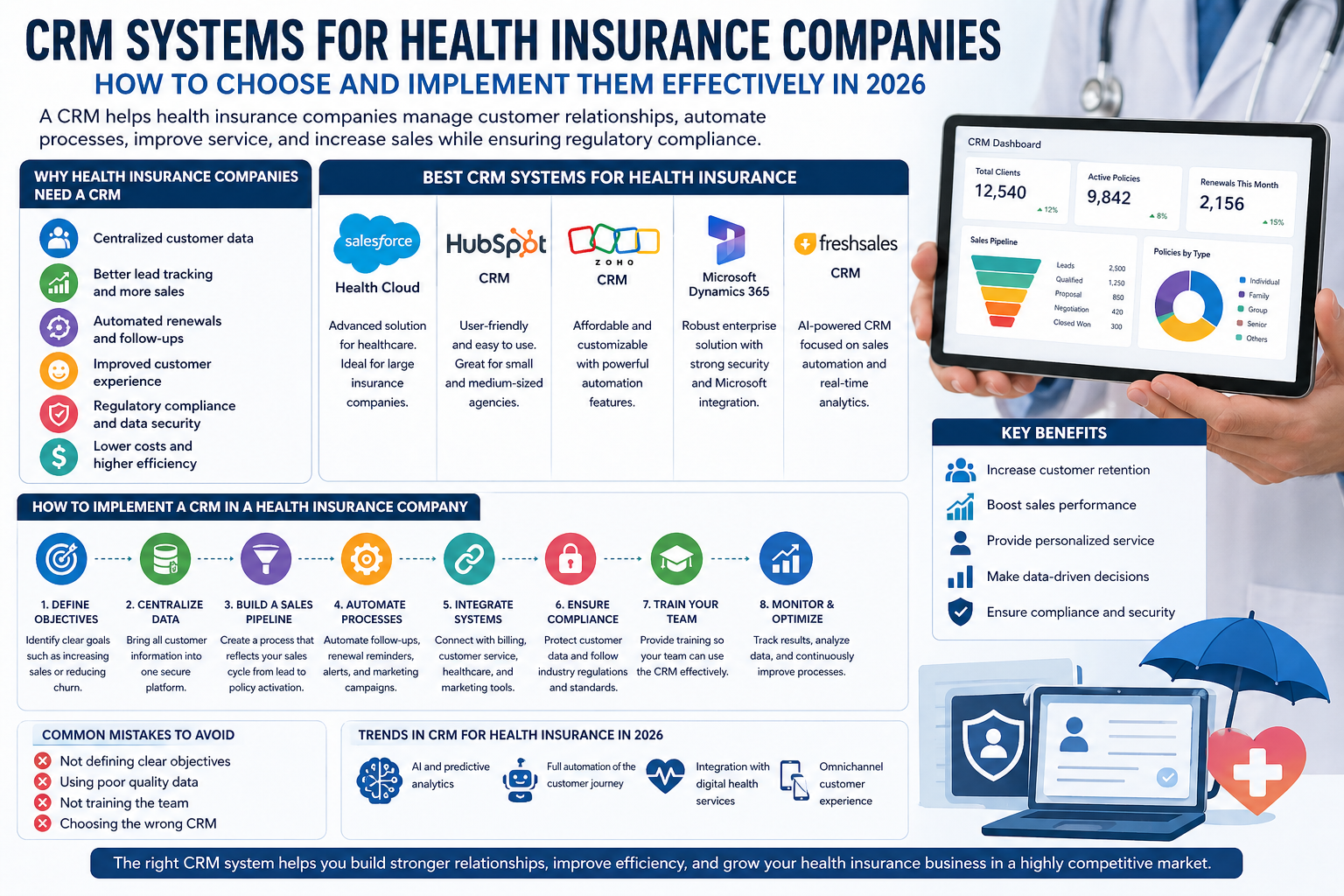
Why Does a Health Insurance Company Need a CRM?
Unlike many other industries, insurance companies handle:
- Sensitive customer data
- Complex sales processes
- Recurring renewals
- Claims management
- Ongoing customer support
A CRM allows businesses to manage all of this from a single platform.
Key advantages:
- Improved lead tracking
- Automated renewal processes
- More personalized customer service
- Reduced human error
- Better regulatory compliance
In essence, a CRM becomes the operational “brain” of the organization.
Types of CRM for Health Insurance
Before selecting a platform, it’s important to understand the main types of CRM systems:
1. Operational CRM
Focused on automating day-to-day activities such as:
- Sales
- Marketing
- Customer service
Ideal for improving daily efficiency.
2. Analytical CRM
Designed to process large volumes of data to:
- Identify customer behavior patterns
- Predict policy cancellations
- Optimize sales strategies
3. Collaborative CRM
Enhances communication between:
- Insurance agents
- Medical teams
- Customer support staff
Essential for larger organizations with multiple departments.
Best CRM Systems for Health Insurance in 2026
Below are some of the most widely used and effective platforms in this sector:
Salesforce Health Cloud
One of the most advanced CRM solutions tailored for healthcare.
Advantages:
- Built specifically for the healthcare industry
- Comprehensive patient/customer management
- Strong compliance capabilities
- Advanced artificial intelligence
Best for:
- Large insurance providers
- Complex operational environments
HubSpot CRM
A flexible and user-friendly option.
Advantages:
- Intuitive interface
- Marketing automation tools
- Lead tracking capabilities
- Wide range of integrations
Best for:
- Small to mid-sized insurance agencies
- Teams seeking ease of use
Zoho CRM
Known for its excellent cost-to-value ratio.
Advantages:
- Built-in artificial intelligence
- Advanced automation features
- High customization
Best for:
- Growing businesses
- Budget-conscious organizations
Microsoft Dynamics 365
A robust enterprise-level solution.
Advantages:
- Seamless integration with Microsoft tools
- High-level security
- Deep customization capabilities
Best for:
- Large enterprises
- Corporate environments
Freshsales
Focused on automation and efficiency.
Advantages:
- Sales process automation
- Intelligent tracking
- Real-time analytics
Best for:
- Agile sales teams
How to Implement a CRM in a Health Insurance Company
Successfully deploying a CRM requires a structured approach. Here’s a step-by-step process:
1. Define Clear Objectives
Before implementation, identify your goals:
- Increase sales?
- Reduce churn?
- Improve customer support?
Example:
Reduce customer churn by 20% through automated follow-ups.
2. Centralize Customer Data
The CRM should store:
- Personal information
- Relevant history
- Active policies
- Previous interactions
This enables more personalized service.
3. Build a Custom Sales Pipeline
In health insurance, the typical process includes:
- Lead
- Needs assessment
- Quote
- Follow-up
- Closing
- Policy activation
The CRM should reflect this workflow.
4. Automate Key Processes
This is where CRM delivers the most value.
You can automate:
- Follow-up emails
- Renewal reminders
- Expiration alerts
- Marketing campaigns
This reduces manual workload and increases productivity.
5. Integrate with Other Systems
The CRM should connect with:
- Billing systems
- Customer service platforms
- Healthcare software (if applicable)
- Marketing tools
Integration prevents data duplication and improves efficiency.
6. Ensure Regulatory Compliance
The healthcare sector requires strict compliance standards.
Your CRM must provide:
- Data protection
- Access control
- Activity tracking
This is crucial to avoid legal issues.
7. Train Your Team
Without proper training, a CRM system will fail.
Train:
- Sales agents
- Customer support staff
- Administrative teams
The goal is to ensure efficient system usage.
8. Monitor and Optimize
After implementation, track performance:
- Conversion rates
- Customer retention
- Response times
- Customer satisfaction
Then refine your strategy based on data insights.
Real Benefits of CRM in Health Insurance
When properly implemented, the results are significant:
1. Improved Customer Retention
Thanks to:
- Continuous engagement
- Personalized communication
- Automated reminders
2. Increased Sales Performance
CRM systems help:
- Identify opportunities
- Prioritize leads
- Improve closing rates
3. Enhanced Customer Experience
Clients receive:
- Faster responses
- Personalized service
- Clear communication
4. Lower Operational Costs
Automation reduces:
- Manual tasks
- Errors
- Administrative expenses
5. Data-Driven Decision Making
CRM platforms provide insights such as:
- Best-selling policies
- Customers at risk of cancellation
- Most effective sales strategies
Common Mistakes When Implementing a CRM
Avoid these pitfalls:
❌ Lack of clear objectives
Without direction, the CRM loses effectiveness.
❌ Poor data quality
Inaccurate data leads to poor decisions.
❌ Insufficient training
Teams fail to use the system properly.
❌ Choosing the wrong CRM
Not all CRM systems fit the insurance sector.
CRM Trends in Health Insurance for 2026
The future of CRM in this industry includes:
- Predictive artificial intelligence
- Fully automated customer lifecycle management
- Integration with digital healthcare services
- Omnichannel customer experiences
Companies that adopt these trends will gain a competitive edge.
Conclusion
CRM systems have transformed how health insurance companies operate. It is no longer just about selling policies—it’s about building strong, long-term relationships with clients.
Solutions like Salesforce Health Cloud, HubSpot CRM, and Microsoft Dynamics 365 provide powerful tools tailored to different business needs.
The key lies in selecting the right platform, implementing it effectively, and properly training your team.
In a market where trust and personalization are everything, a well-executed CRM strategy can become the most valuable asset for any health insurance company.

